
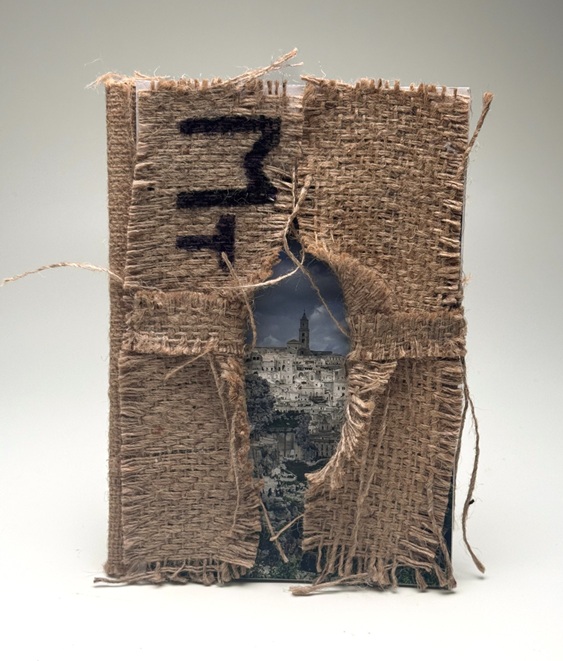
CARLA CANTORE. MT OPERA UNICA. Window Gallery De Prachtvink in Groningen
Arte
Window Gallery De Prachtvink, Platinalaan 505a, 9743 , Groningen, GZ, 9743, Netherlands
01/03/2025 - 31/03/2026
From March 1 to 31, 2026, Window Gallery De Prachtvink in Groningen presents “MT Opera Unica”, the first solo exhibition in the Netherlands by Italian artist Carla Cantore, curated by Paul Marius Viscount.
Born in Matera, Cantore stands out within the European art scene for a practice centered on materiality as a tool for investigating identity and culture. Her work unfolds between Italy and across Europe through a language that integrates installation, photography, and the artist’s book, creating visual dispositifs capable of interweaving memory, territory, and contemporary reflection.
With this project, MIP – Matera International Photography APS – ETS strengthens and expands its international network of collaborations, fostering dialogue among European territories and cultural institutions through a program that intertwines visual arts and interdisciplinary research.
MT Opera Unica explores matter as a site of sensory encounter and as a repository of collective memory, through an installation that activates a profound dialogue between body, space, and history. The work unfolds through a stratification of materials and meanings, in which each element contributes to constructing a perceptual field that engages visitors in a direct and physical way.
Jute recalls the sacks used to transport grain in the rural landscape surrounding Matera, evoking memories of labor, hardship, and survival. White simultaneously refers to flour—the primary ingredient of Matera’s traditional bread, still produced today in its historic form—and to tuff stone, the foundational material of the Rioni Sassi, symbol of an archaic, resilient, and time-layered way of dwelling.
Through these references, the installation establishes a dialogue between nourishment and shelter, between material survival and symbolic dimension. Home and bread emerge as universal archetypes: the home as a space of protection and inner reconciliation; bread as an element that traverses cultures and religions, bearing both physical and spiritual value.
In Cantore’s work, white is not conceived as absence, but as a field of potential. It becomes a generative space in which language transforms, opens to new expressive possibilities, and renders visible the relationship between personal history and collective memory. Matter thus becomes a surface of writing and a place of translation, where literary and symbolic inspiration take tangible form.
Within the installation, photography of Matera acts as a poetic and perceptual device, making the invisible visible and activating reflection on the relationship between time, identity, and territory. Not as mere documentation, but as a presence capable of connecting the artist’s place of origin with the exhibition space, creating a bridge between intimate geographies and international contexts.
MT Opera Unica presents itself as an immersive and deeply symbolic work that connects memory and place, tradition and contemporary artistic language. The installation invites the public to a shared reflection on themes of origin, transformation, and belonging, assuming particular significance in the context of Matera’s designation as Mediterranean Capital of Culture and Dialogue 2026, reaffirming the role of art as a space of relationship, listening, and collective meaning-making.
Biography
Carla Cantore is a contemporary Italian visual artist, born in Matera and active across Europe. Her research investigates human nature in its relational and psychological dimensions, exploring the relationship between self and environment. Through processes of observation, manipulation, and creation, the artist conducts an introspective inquiry that reflects on the construction of identity.
Cantore’s creative process reshapes inner experience, intertwining social and spiritual reflection. Her investigation addresses the complex layers of personality formation, the nature of the soul, and the dynamics of consciousness, exploring the relationship between body, space, and history. She transforms everyday materials into immersive, site-specific works that activate dialogue between tradition, identity, and contemporaneity.
Cantore works across multiple artistic languages—photography, video, writing, Mail Art, and the artist’s book—combining experimentation and narrative. She favors humble and recycled materials, chosen for their historical and symbolic stratification, capable of generating new meanings through renewed forms and functions. She often integrates photography and installation, transforming the image into a tool of resistance and critical reflection, offering a lens through which to interpret the world and the invisible relationships that traverse it.
Reading places—even abandoned ones—becomes a tool of inquiry between analogy and difference: Cantore interprets them as archives of domestic and familial memory, transforming them into narratives of territory that provoke questions, challenge consolidated beliefs, and generate emotional and conceptual connections. Her experience as an art therapist enriches her artistic practice, making visual language a tool of individual and collective transformation. She has also curated exhibitions and organized cultural events.
In works such as MIRRORLESS – senza specchio, dedicated to eating disorders, the artist adopts an essential visual language, free of emphasis, accompanying experience without overlapping it. With Materacreativity – Luoghi di energia creativa, created together with Antonello Di Gennaro, the project reveals the vibrant energy of Matera, Matera Capitale Europea della Cultura 2019, exploring ancient places where energy flows from earth to sky, creating an invisible bridge between human beings, nature, and cosmos—a visual and sensory journey celebrating creativity as a vital and universal force.
Cantore has exhibited in numerous national and international galleries and museum spaces, including Buenos Aires, the Principality of Monaco, Plovdiv, Rome, Bari, Milan, Vicenza, and Turin, participating in projects with prominent figures such as Mario Cresci, Luigi Ghirri, Giovanni Gastel, Oliviero Toscani, Maurizio Galimberti, Michelangelo Pistoletto, Lucio Fontana, Arnaldo Pomodoro, Bruno Munari, Gillo Dorfles and Joseph Beuys.
Her works are held in private and public collections, including the MAM – Museo d’Arte Moderna e della Mail Art di Montecarotto, the Museo Dinamico della Mail Art di Quiliano, and Spazio Hajech – Brera. A lecturer in the second-level Master’s program in Neuroaesthetics at the Università degli Studi di Roma Tor Vergata, she leads workshops and programs in photography and art therapy within educational and socio-health contexts, strengthening the connection between artistic practice, research, and individual and collective transformation.
